
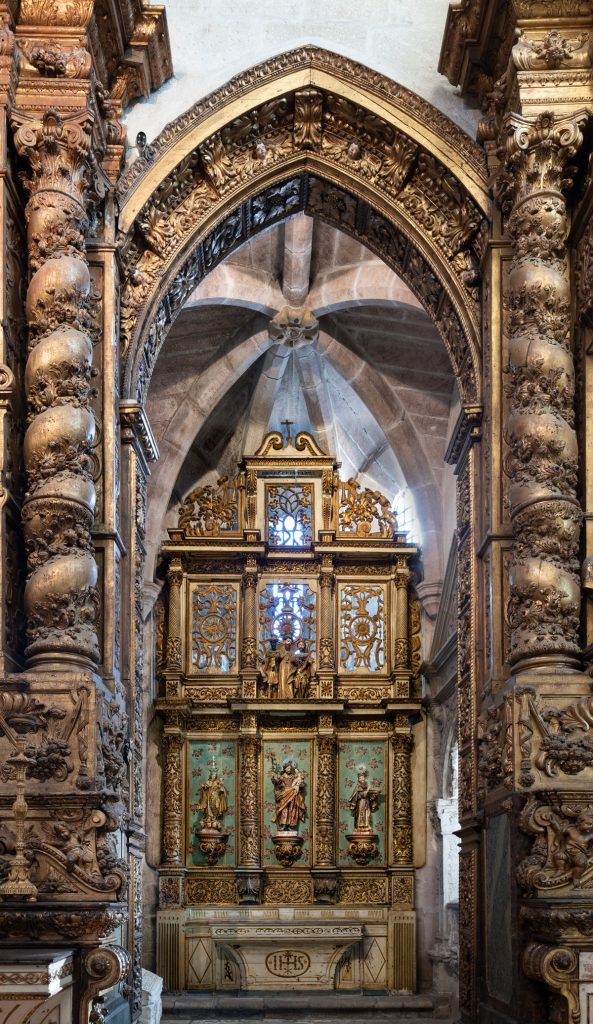
Capela dos Brandão
The Brandão Family Chapel
Retábulo colateral dos Reis Magos
Collateral Altarpiece of the Magi
Capela | Chapel: Instituída em 1543| Consecrated in 1543
Retábulo | Altarpiece: Século XVII | 17th century
Período/Estilo | Period/Style:
Capela: Gótico e Renascimento | Chapel: Gothic and Renaissance
Retábulo | Altarpiece: Maneirista/Protobarroco | Mannerist/Proto-Baroque
A capela, de traça gótica, ficou conhecida como panteão da família Brandão Pereira, importante família portuense desde o século XV.
Do lado direito, encontram-se dois túmulos enquadrados por um alçado de desenho renascentista. A arca superior apresenta somente uma inscrição, que refere a identidade do tumulado, Fernão Brandão Pereira, e assenta sobre as esculturas de três leões. O leão do centro segura as armas da família. Por baixo, um túmulo mais antigo, apresenta caracteres góticos e dois escudos, semi-encobertos.
A arca tumular do lado esquerdo, em calcário, apresenta a mesma linguagem decorativa renascentista. Exibe a data de 1501, entre figuras fantásticas que expõem as armas dos Brandão e elementos de decoração vegetalista. (a julgar pela dimensão, esta será um memorial fúnebre e não um túmulo).
O retábulo desta capela, dedicado aos Reis Magos, que figuram no nicho central superior, é o de execução mais antiga ainda existente na igreja de São Francisco, podendo ser datado, com muita probabilidade, da primeira metade do século XVII.
A grande profusão de relevos e os temas decorativos de inspiração clássica romana que apresenta, nomeadamente no registo inferior, que leva ao preenchimento total dos fustes das suas colunas, determina a sua integração numa fase da talha dourada portuguesa designada por Protobarroco. Na parte inferior, encontramos São José, ladeado por Nossa Senhora do Carmo e São João Damasceno.
Os painéis de talha vazados que permitem a entrada de luz na parte superior, são acrescentos posteriores que terão substituído pinturas, imagens ou painéis com relevo. Outra intervenção posterior introduziu-lhe o branco de leite, quando originalmente era todo dourado. O mesmo se passou com a mesa de altar, do período neoclássico.
The chapel, in Gothic style, became known as the pantheon of the Brandão Pereira family, an important Porto family since the 15th century.
On the right, there are two tombs framed by a relief of Renaissance design. The upper casket has only one inscription, with the name of the entombed, Fernão Brandão Pereira, and rests on the sculptures of three lions. The lion in the centre bears the family coat of arms. Below, an older tomb with Gothic characteristics features two half-concealed shields.
The limestone tomb chest on the left features the same Renaissance decorative grammar. It bears the date 1501, among fantastic figures displaying the Brandão family’s coat of arms and vegetal decorative elements. Judging by its size, this is a funerary memorial and not a tomb.
The altarpiece in this chapel dedicated to the Magi in the upper central niche proves to be the oldest one in the Church of Saint Francis and can be dated with a high degree of probability to the first half of the 17th century.
The great profusion of reliefs inspired by the decorative panels of classical Roman architecture feature, particularly in the lower register, which completely fills the shafts of its columns, means that it is part of the final phase of this period, known as the Proto-Baroque. Below, we see St. Joseph, flanked by Our Lady of Mount Carmel and St. John Damascene.
The hollowed-out carved panels that allow light into the upper tier are later additions that probably replaced paintings, images or panels with reliefs. One other later intervention was the introduction of milk white in areas that were originally all gilt. The same is true of the altar table, from the Neoclassical period.