
Retábulo dos Mártires de Marrocos
Altarpiece of the Martyrs of Morocco
Data: Segunda metade do século XVIII
Período/Estilo: Rococó
Entalhador: Atribuído a Manuel Pereira da Costa e Noronha

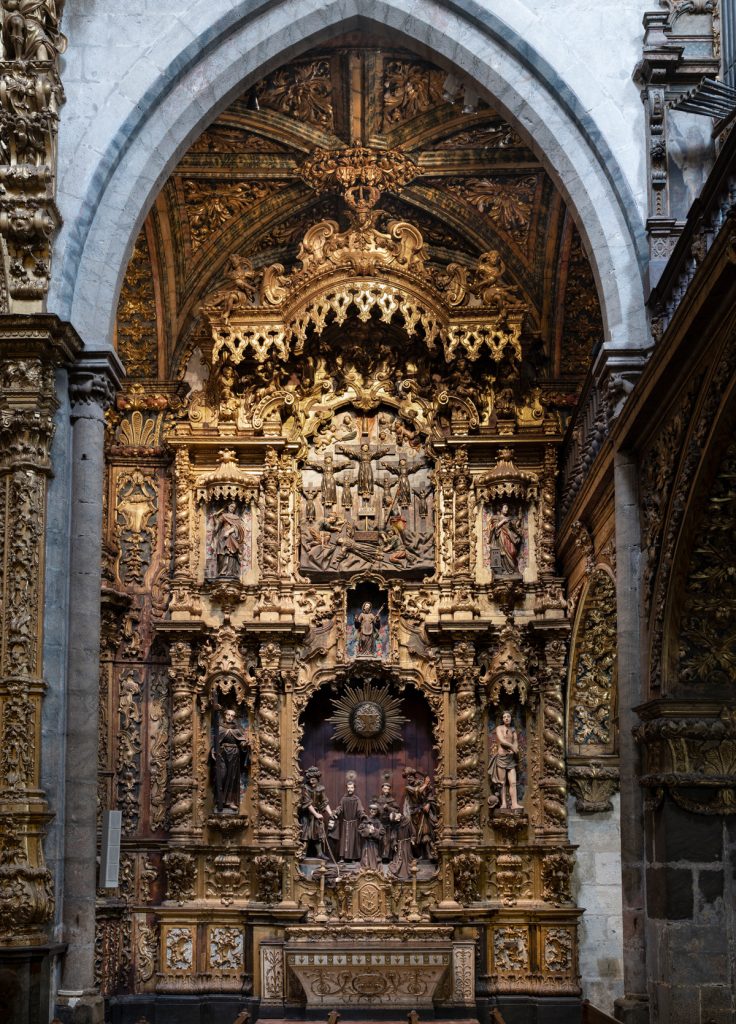
Retábulo policromado e dourado com destaque para a representação cenográfica dos Mártires de Marrocos, nas esculturas do nicho central inferior, e dos Mártires do Japão, no painel relevado, no andar superior.
Estes dois episódios, ocorridos nos séculos XIII (em Marrocos) e XVI (no Japão), representam momentos históricos exemplares uma vez que os monges franciscanos foram protagonistas e morreram no cumprimento da sua missão evangelizadora nesses países.
Entre os dois andares, um pequeno nicho exibe a figura de São Gualter, santo que o próprio São Francisco enviou, em 1217, para estabelecer a Ordem dos Franciscanos em Portugal.
As restantes esculturas deste altar, representam São Pedro de Alcântara (lado esquerdo, em baixo) e São Manuel (lado direito, em baixo), Santa Sancha e Santa Bárbara (nos nichos laterais superiores).
A profusão de talha dourada, os elementos decorativos utilizados (conchas, espirais, marmoreados) e o dinamismo e assimetria que os motivos deste altar apresentam, enquadram-no no estilo Rococó.
A mesa de altar é já posterior, manifestando a estética do período neoclássico.

Polychrome and gilt altarpiece with a scenographic depiction of the Martyrs of Morocco in the sculptures in the central chamber and the Martyrs of Japan in the relief panel on the upper tier.
These two episodes, which took place in the 13th (Morocco) and 16th (Japan) centuries, represent exemplary historical moments since Franciscan monks were the protagonists who died in the fulfilment of their evangelising mission in those countries.
In between the two tiers, in a central niche, there is an image of Saint Gualter, the saint that St. Francis himself sent in 1217 to establish the Franciscan Order in Portugal.
On the lower tier, we can see the Franciscan St. Peter of Alcantara on the left, and St. Manuel on the right. Saint Sancha appears on the left and Saint Barbara on the right on the upper tier.
The profusion of gilt woodcarvings, the decorative elements used (shells, spirals, and marbling) and the dynamism and asymmetry of the motifs on this altar all suggest the Rococo style.
The altar table is from a later date, and incorporates Neoclassical aesthetics.