Capela de Santo António
Chapel of Saint Anthony
Retábulo colateral de Santo António
Collateral Altarpiece of Saint Anthony
Talha do arco| Woodcarvings of the arch: 1724
Retábulo | Altarpiece: Segunda metade do século XVIII; Second half of the 18th century
Período/Estilo | Period/Style: Talha do arco, Estilo Nacional ou Barroco Pleno
Woodcarvings of the arch: Full Baroque or National Style
Retábulo | Altarpiece: Rococó | Rococo
Artistas envolvidos | Contributing artists:
Arco | Arch: Luís Pereira da Costa
Retábulo | Altarpiece: Desconhecido | Unknown
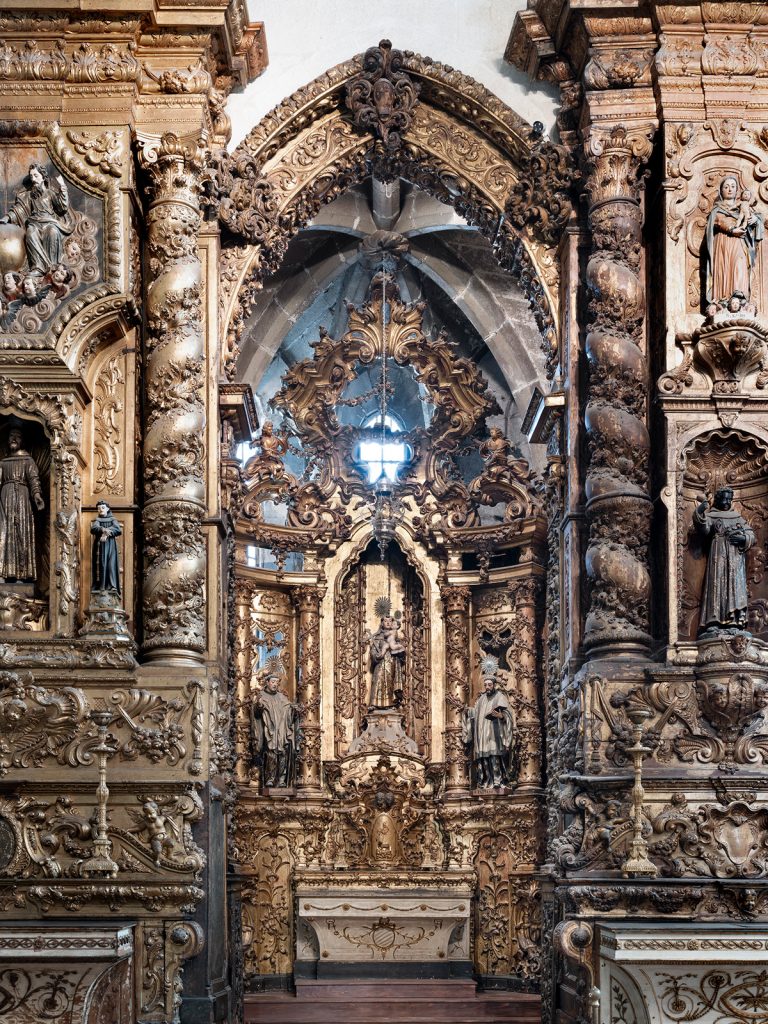
O arco de talha desta capela foi executado por Luís Pereira da Costa, um dos maiores entalhadores do Porto, que participou também na talha do altar-mor da Sé do Porto. Apresenta uma gramática decorativa característica do Barroco Pleno e completava o conjunto decorativo que incluía o altar dedicado a Santo António, substituído mais tarde pelo actual, de estilo rococó.
O retábulo, encomendado pela confraria de Santo António, é característico do Rococó, apresentando um risco dinâmico, com um jogo de planos côncavos e convexos, exibindo uma cascata de folhas, conchas e volutas, que se projectam até ao chão nas laterais do conjunto; uma inovação trazida por este estilo aos retábulos portugueses e conferindo um movimento e graça próprios do excelente trabalho que o entalhe rococó atingiu no Porto.
No centro, destaca-se a imagem de Santo António, num nicho central elevado, por cima do sacrário. Nos tramos laterais surgem São Francisco Xavier (à esquerda) e São Caetano (à direita). Toda a parte superior é vazada, permitindo a entrada de luz pelas primitivas frestas góticas da capela.

The woodcarving arch of this chapel was executed by Luís Pereira da Costa, one of Porto’s greatest carvers, who also participated in the carving of the high altar of Porto Cathedral. It has a decorative grammar characteristic of the Full Baroque and completed the decorative ensemble that included the altar dedicated to St Anthony, later replaced by the current altar in the Rococo style.
Commissioned by the Confraternity of St. Anthony, the altarpiece is characteristic of the Rococo style. Its dynamic design is subject to a play between contradictory concave and convex planes, and it displays a cascade of leaves, shells and volutes, which continue onto the floor on the sides of the altarpiece, an innovation that lends to the altarpiece a movement and grace so typical of the excellent workmanship that Rococo woodcarving achieved in Porto.
In the centre, the statue of Saint Anthony is prominent, in a central niche raised above the sacrarium. In the lateral sections there stand St. Francis Xavier on the left and St. Cajetan on the right. The entire upper part is hollowed out so that light can enter the space through the original Gothic lancet windows of the chapel.