
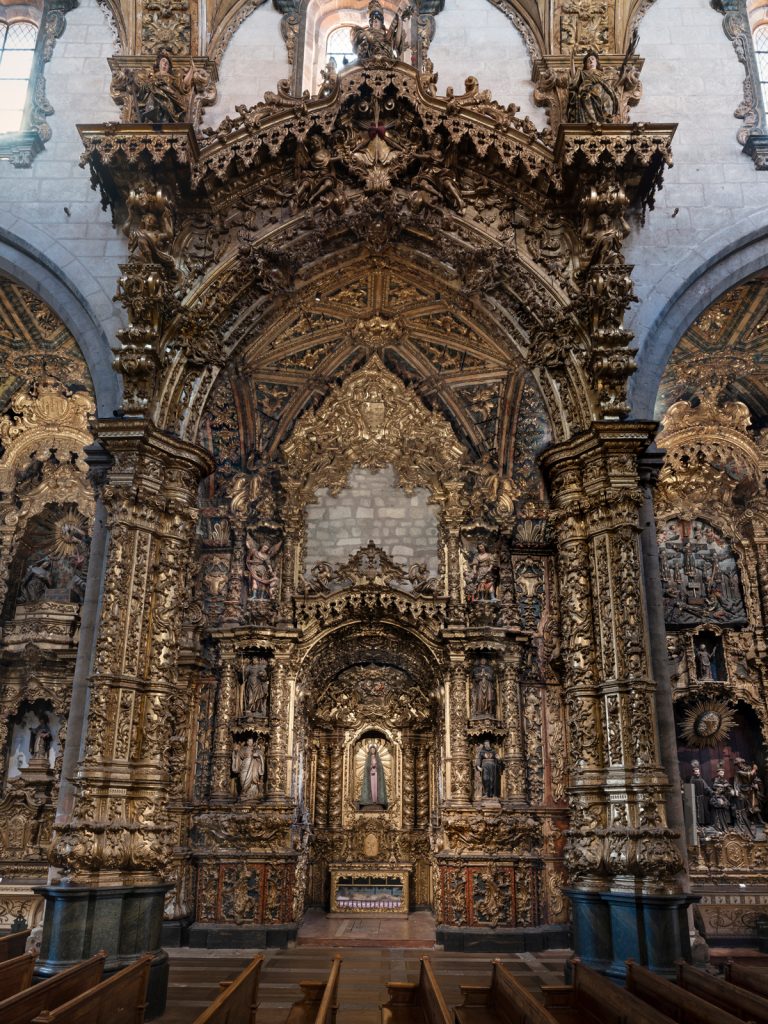
Capela de Nossa Senhora da Soledade
Chapel of Our Lady of Solitude
Data: 1764
Período/Estilo: Rococó
Entalhador: Francisco Pereira Campanhã

Capela particular instituída pela família portuense Pinto Monteiro (cujas armas de família se encontram no arco), e cuja produção coube a um dos maiores nomes do Rococó da escola portuense – o mestre escultor Francisco Pereira Campanhã – resultando num dos trabalhos mais conseguidos pelo artista, não só pelas dimensões, mas principalmente pela mestria de entalhe, delicadeza e requinte de execução.
No remate do retábulo, totalmente revestido a folha de ouro, exibe-se, através de um relevo policromado, a representação do Milagre da Porciúncula. Neste milagre, tão caro à ordem franciscana, Nossa Senhora e Jesus Cristo aparecem a São Francisco, enquanto este rezava na capela da Porciúncula, em Itália, perto de Assis.
No corpo do retábulo, destaca-se a escultura de Nossa Senhora da Soledade, a mãe que chora a morte do Filho, no momento entre a Sua Crucifixão e a Sua Ressurreição, encontrando-se por baixo da mesa de altar a imagem de Cristo Morto.
Todo o espaço é revestido por talha dourada, com formas decorativas que conferem grande movimento e dinamismo ao conjunto, com pequenos lóculos encerrados por vidro, no tecto da capela, onde outrora se expunham relíquias de santos, culminando na monumental grade que restringe o acesso a esta capela e que constitui uma obra-prima do entalhe rococó português.
Intencionalmente, na parte exterior, ladeando a entrada na capela, a talha segue o mesmo modelo compositivo do altar que lhe faz frente na outra nave lateral da igreja, criando unidade com essa talha, que já existia no templo quando esta foi executada. Nesta zona destacam-se as imagens de São Diogo de Alcalá e São Bernardo de Claraval (lado esquerdo) e São Pascoal de Bailão e São Bernardo de Corleone (lado direito), encimados por dois arcanjos.

This private chapel was consecrated by the Pinto Monteiro family of Porto (whose family coat of arms is on the arch) and was built by one of the greatest names of the Rococo school in Porto – master sculptor Francisco Pereira Campanhã. It is considered one of the most accomplished works by this artist, not only because of its size, but because of its masterful woodcarving and the delicacy and refinement of its execution.
In the finial of the altarpiece, which is completely covered in gold leaf, there is a polychrome relief depicting the Miracle of the Porziuncola. This miracle, so dear to the Franciscan Order, shows Jesus and Mary appearing to St. Francis while he was praying in the Porziuncola chapel in Italy, near Assisi.
The body of the altarpiece features a sculpture of Our Lady of Solitude, the mother who mourns the death of her Son during the interval between his Crucifixion and Resurrection, and the image of the Dead Christ beneath the altar table.
The entire space is covered in gilt woodcarvings, with decorative shapes that confer on this bel composto – a total work of art – a great deal of movement and dynamism, with small glass-enclosed loculi on the chapel’s ceiling where saints’ relics were once displayed, culminating in the monumental grille that restricts access to the chapel and which is a masterpiece of Portuguese Rococo carving.
On the exterior flanking the entrance to the chapel, the woodcarving intentionally follows the same Composite model as the altar that faces it in the other lateral nave of the church, creating unity with the woodcarving which already existed in the church at the time when this chapel was executed. Niches in the arched entrance to the chapel feature the images of St. Diogo of Alcalá and St. Bernard of Clairvaux (on the left), and St. Paschal of Bailon and St. Bernard of Corleone (on the right), with two archangels on the uppermost tier.